


Marco Polo — The Most Famous Explorer From Venice
Few names in world history evoke the same sense of adventure as Marco Polo. Born in Venice in 1254, he grew up to become the most influential merchant-traveller of the Middle Ages. His journey along the Silk Road and his service at the court of Kublai Khan opened Europe’s eyes to the wonders of Asia and helped shape the way we imagine long-distance travel even today.
For travellers exploring Venice, understanding Marco Polo’s life is more than learning history — it’s discovering how a Venetian merchant changed the world.
A Venetian Childhood in a City of Traders
Marco Polo was born into a wealthy family of merchants who had already established strong connections with the East. Venice in the 13th century was the beating heart of Mediterranean trade: spices, silk, salt, and precious stones flowed through its ports every day.
His father Niccolò and his uncle Maffeo had already travelled thousands of kilometres across Asia. When Marco was just a teenager, they invited him to join their next extraordinary mission — a journey that would last more than 24 years.
The Great Journey Begins: Venice to China
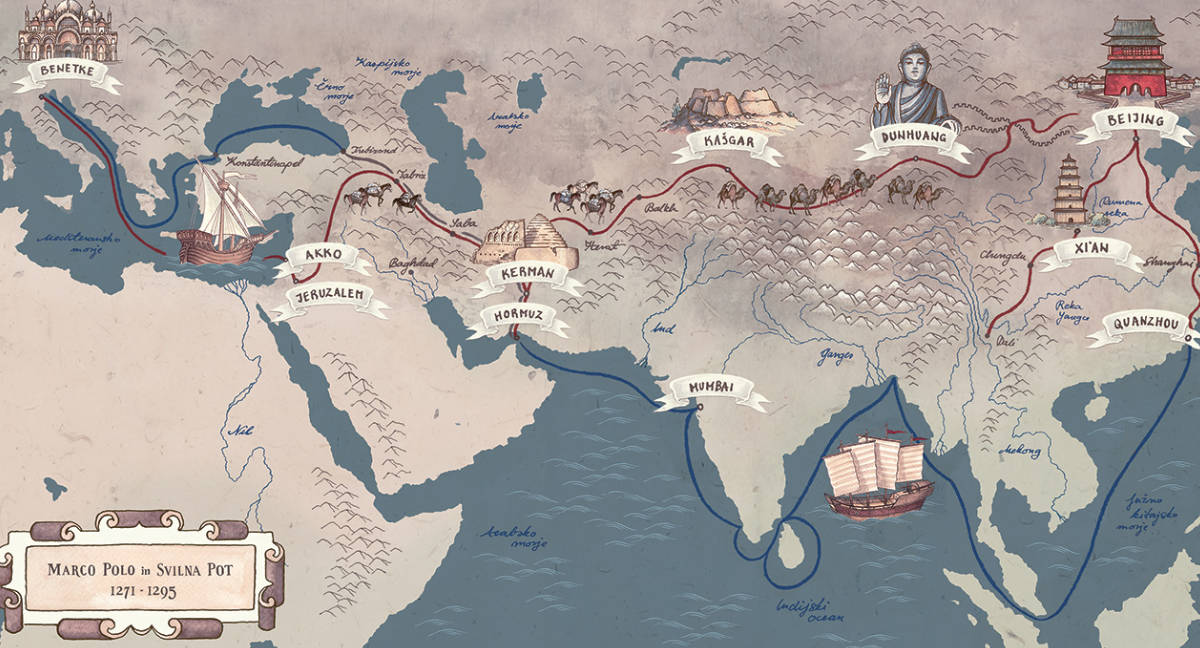
In 1271 the Polos set off from Venice, crossing the Middle East and following the legendary Silk Road. They travelled through Armenia, Persia, the Pamir Mountains, and the Gobi Desert — regions that were almost completely unknown to Europeans at the time.
After years of dangerous travel, they finally reached Shangdu, the summer residence of Kublai Khan, the powerful Mongol emperor who ruled over the largest empire the world had ever seen.
At the Court of Kublai Khan
Kublai Khan was fascinated by the Polos, especially young Marco, who quickly learned Mongolian, Persian, and Chinese dialects. The Khan appointed him as an emissary, sending him across China to observe cities, trade routes, and customs.
Marco Polo’s descriptions of:
-
Massive cities like Beijing,
-
Efficient postal systems,
-
Paper money,
-
Coal as a source of fuel,
-
Grand palaces and advanced markets,
were unlike anything Europe had ever heard before. His accurate observations made him one of history’s first great travel writers.
The Long Voyage Home
After nearly two decades in Asia, the Polos asked Kublai Khan for permission to return to Venice. Their journey back was just as remarkable: they travelled by sea along the coasts of Southeast Asia, through India, and across the Arabian Sea before finally reaching their city in 1295.
They returned rich with jewels, rare fabrics, and stories of a world that most Europeans could not imagine.
Marco Polo Becomes a Legend
Shortly after his return, Marco Polo was captured during a naval conflict between Venice and Genoa. In prison he met a writer named Rustichello da Pisa, to whom he dictated his experiences. The result was Il Milione, better known in English as The Travels of Marco Polo — one of the most important travel books ever written.
The book spread rapidly across Europe, inspiring generations of explorers. Even Christopher Columbus carried a copy on his own voyage to the Americas.
Where to Discover Marco Polo in Venice Today
Venice still carries the traces of its great explorer. Travellers can visit:
-
Corte del Milion — the area where the Polo family once lived.
-
Rialto Market, where Marco Polo would have seen goods arriving from distant worlds.
-
The Maritime Museum (Museo Navale), which tells the story of Venetian navigation and trade.
At Vidal Venice Tours, we often sail through the same waters Marco Polo used when he first left his homeland — a reminder of how Venice shaped brave explorers for centuries.
Why Marco Polo Matters Today
Marco Polo’s life is a symbol of curiosity, cultural exchange, and open-minded exploration. He connected Venice to Asia, blending worlds that had never met before. For modern travellers, his story is an invitation to see Venice not only as a city of art and canals, but as the birthplace of one of the greatest adventurers in history.
Related articles: