


The Lace of Burano: Discover the Timeless Art of Venetian Craftsmanship
A journey into the history, traditions and extraordinary craftsmanship behind one of Venice’s most precious treasures.
When people think of Burano, they often imagine colourful houses reflected in quiet canals, fishing boats tied along the waterfront and picturesque streets that seem to belong in a painting. But beyond its famous colours, this small island in the Venetian Lagoon holds another extraordinary treasure: its centuries-old tradition of handmade lace.
Known throughout Europe for its delicate patterns and extraordinary craftsmanship, Burano lace is much more than a decorative textile. It represents generations of local women, family traditions and an important chapter in the cultural history of Venice.
Today, discovering the art of Burano lace is one of the most fascinating experiences for visitors exploring the Venetian Lagoon.
Let’s discover its origins, the secrets behind its creation and where you can still experience this remarkable tradition.
1. The Origins of Burano Lace: A Tradition Born in the Venetian Lagoon
The history of Burano lace dates back to at least the 16th century, when Venetian needlework began gaining recognition among Europe’s wealthiest families.
There is even a beautiful local legend explaining its origins.
According to the story, a fisherman from Burano resisted the enchanting songs of a mermaid because he was faithful to his fiancée. As a reward, the Queen of the Mermaids created a magnificent wedding veil from sea foam and presented it to him. When the fisherman returned home, his fiancée’s beautiful veil inspired the women of Burano to reproduce its delicate patterns using needles and thread.
Although this is only a legend, it captures the romantic relationship between the island, the sea and its traditional craftsmanship.
Historically, the development of Venetian lace was closely connected to the prosperity of the Republic of Venice. During the Renaissance, lace became a highly desirable luxury product, particularly among European aristocracy and royal courts.
By the 17th century, Venetian lace had become internationally renowned, adorning elaborate dresses, collars, religious garments and other prestigious accessories.
Burano gradually established itself as one of the most important centres of this extraordinary craft.
2. What Makes Burano Lace So Special?
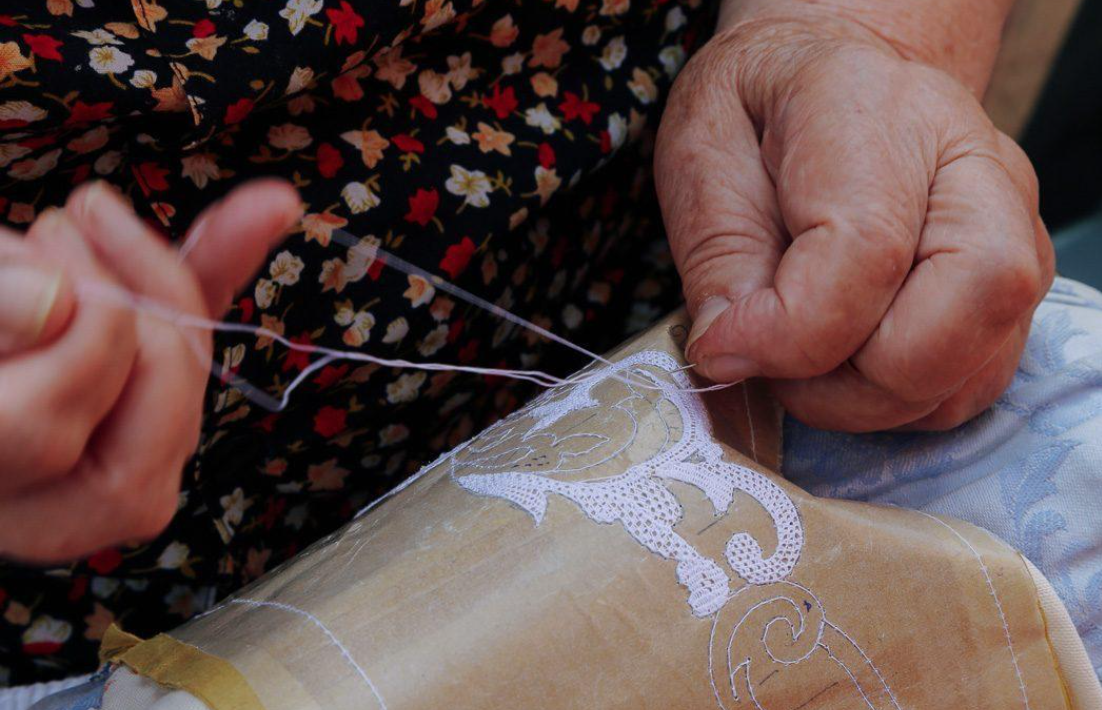
Unlike ordinary embroidery, traditional Burano lace is created using a remarkably delicate technique known as punto in aria, meaning “stitch in the air”.
The technique uses only a needle and thread, without an underlying fabric to support the design.
The lacemaker begins by tracing a pattern onto parchment or another temporary support. Working with extraordinary precision, she creates a network of tiny stitches that gradually form intricate flowers, geometric shapes, leaves and other decorative motifs.
The result is an exceptionally delicate piece of lace that appears almost weightless.
Traditional Burano lace is particularly famous for its fine details, complex patterns and extraordinary precision.
Creating even a relatively small piece can require many hours of painstaking work, while more elaborate pieces may take months or considerably longer to complete.
This is precisely why authentic handmade Burano lace is so valuable: every piece represents an enormous investment of skill, patience and experience.
3. The Golden Age of Burano Lace and the European Royal Courts
During the 16th and 17th centuries, Venetian lace became one of the most prestigious luxury products in Europe.
The craft received an important boost from Morosina Morosini, the Dogaressa of Venice, who supported the establishment of a lace-making workshop employing approximately 130 women.
The demand for Venetian lace grew enormously, and its popularity extended far beyond the borders of the Republic.
Royal families and aristocrats throughout Europe wanted these exquisite creations for their wardrobes and residences.
Venetian needle lace became particularly famous for its elaborate relief patterns, including the celebrated Gros Point de Venise.
Such was its reputation that French authorities eventually encouraged domestic lace production to compete with the expensive Venetian imports.
The influence of Venetian lace-making spread across Europe, helping establish lace as a symbol of elegance, wealth and social status.
4. The Burano Lace School: Saving an Almost Forgotten Art
Despite its extraordinary success, the lace-making tradition experienced a significant decline during the following centuries.
Changing fashions, industrialisation and the increasing availability of cheaper manufactured textiles made handmade lace less commercially competitive.
By the 19th century, the tradition was at risk of disappearing.
A remarkable revival began in 1872, thanks to Countess Andriana Marcello and the support of Paolo Fambri.
Their initiative aimed not only to preserve an important Venetian artistic tradition but also to provide economic opportunities for the women of Burano, whose families had traditionally depended on fishing and other lagoon activities.
The revival was made possible by an elderly local lacemaker who still possessed the knowledge of the traditional techniques. She passed her skills to a new generation, allowing the establishment of the famous Burano Lace School.
The school became extremely successful, attracting students and commissions from wealthy patrons, including members of European royal families.
For decades, generations of women learned and practised the art of lace-making there.
The school eventually closed in the early 1970s, but its historical legacy remains an essential part of Burano’s identity.
Today, the former school building houses the Museo del Merletto, dedicated to preserving and showcasing this extraordinary heritage.
5. Visit the Burano Lace Museum
If you want to understand the history of Burano lace, a visit to the Museo del Merletto is highly recommended.
Located in Piazza Galuppi, the island’s main square, the museum occupies the historic building that once housed the famous Burano Lace School.
Inside, visitors can admire a remarkable collection of historical lace creations, illustrating the evolution of Venetian craftsmanship from the 16th century to the modern era.
The exhibition also explains the different techniques, patterns and materials used throughout the centuries.
One of the most interesting aspects of the museum is the opportunity, during scheduled demonstrations, to observe experienced lacemakers working with needle and thread.
Watching their hands move with such precision is an extraordinary experience. It becomes immediately clear why authentic Burano lace requires years of practice and dedication.
For anyone interested in Venetian history, traditional crafts or Italian culture, this small museum offers a fascinating insight into an important part of the lagoon’s heritage.
6. Where to Find Authentic Handmade Burano Lace Today
Walking through Burano, you will find numerous shops displaying beautiful lace products, from small decorative accessories to elaborate tablecloths, collars and traditional garments.
However, there is something important to remember: not everything sold as Burano lace is necessarily handmade on the island.
Because genuine needle lace requires so much time and expertise, many commercially available products are machine-made or produced elsewhere.
If you are interested in purchasing an authentic piece, take your time and ask about its origin and how it was made.
Look for specialist workshops and sellers who can explain the techniques and provenance of their products.
Whenever possible, choose pieces made by local artisans. Supporting traditional craftsmanship helps preserve the knowledge and skills that make Burano so special.
An authentic handmade piece of Burano lace is not simply a souvenir. It is a small piece of Venetian cultural history that you can take home.
7. Discover Burano from the Water: A Different Perspective on the Venetian Lagoon
Although Burano is famous for its colourful houses and lace-making tradition, the journey to the island is an experience in itself.
Located in the northern part of the Venetian Lagoon, Burano is surrounded by shallow waters, fishing channels, salt marshes and small islands that have shaped the lives of local communities for centuries.
Travelling by boat allows you to appreciate a completely different side of Venice, far away from the crowded streets around St. Mark’s Square.
You can admire the traditional fishing landscape, observe the characteristic lagoon vegetation and discover the quieter waterways connecting the islands.
At Vidal Venice Tours, we believe that experiencing Venice means going beyond its most famous monuments.
Our private boat excursions are designed to introduce visitors to the authentic Venetian Lagoon, combining local knowledge, history and beautiful scenery.
On our Discover Murano, Burano and Torcello private boat tour, you can explore three of the lagoon’s most fascinating islands in approximately 3.5 hours.
During your visit to Burano, you will have time to walk through its colourful streets, discover its traditional lace-making heritage and experience the atmosphere of this unique fishing island.
Our tours are operated by local Venetian skippers who know the lagoon, its history and its traditions firsthand.
For those wishing to explore further, our Northern Lagoon and Sile River Escape offers a longer private experience, combining the famous islands with quieter waterways and some of the lagoon’s lesser-known landscapes.
We believe the best way to discover Venice is not simply to visit its landmarks, but to understand the people, traditions and environment that make it unique.
8. Burano: A Living Heritage Worth Preserving
Today, Burano remains one of the most recognisable and beloved islands in the Venetian Lagoon.
Its colourful houses attract photographers and travellers from all over the world, but its identity goes much deeper than its picturesque appearance.
The tradition of lace-making tells the story of an island shaped by the sea, where generations of women transformed patience, creativity and technical skill into an internationally recognised art form.
Although the number of traditional lacemakers has declined considerably, their knowledge remains an important part of Burano’s cultural identity.
Visiting the island, learning about its history and supporting genuine local craftsmanship are meaningful ways to help keep this heritage alive.
And perhaps that is the real beauty of Burano: behind every colourful façade and every delicate lace pattern, there is a story waiting to be discovered.
Related articles: